A special-ball field creates two probability questions that are easy to confuse. One asks whether the Thunderball matches, regardless of the main-number result. Another asks for a particular main-match count together with the Thunderball. The first event is broader, so its simple probability should not be pasted beside an exact prize category without checking the remaining conditions.
A careful explanation of thunderball odds keeps five main numbers from 39 and one Thunderball from 14 visible throughout. The main set and special field are separate. The full top match requires both, while lower events specify different combinations of main matches and the Thunderball condition.
The jackpot combines a set and a single value
There are 575,757 possible five-number main sets from a 39-number field. The order of the five selected values does not matter, so different arrangements of the same members are counted once. Each main set can be paired with any of the 14 permitted Thunderballs.
That gives 8,060,598 complete selections. One particular valid complete line has a one-in-8,060,598 chance of the full top match in a fair draw. The larger denominator follows from including the special field, rather than from a different probability assigned to the same main set.
A Thunderball match alone is a marginal event
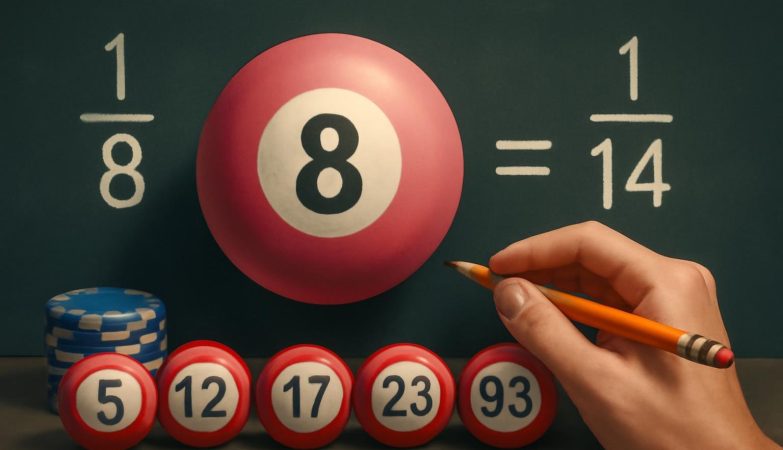
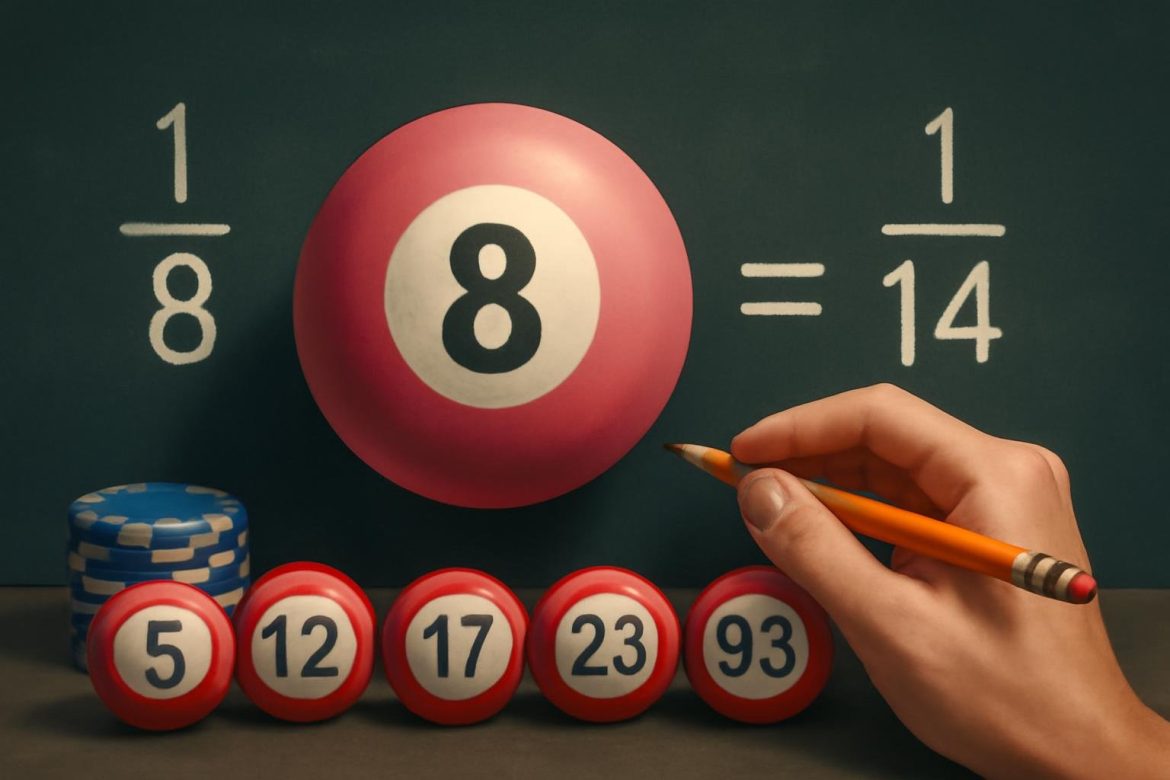
For one fixed permitted Thunderball, the chance of matching the drawn Thunderball is one in 14 under the fair-draw model. This statement ignores the main-number outcome. It includes cases with no main matches, some main matches and all five main matches.
An exact category described as no main matches plus the Thunderball is narrower. Its probability must include the no-main-match condition. Calling that exact event one in 14 would incorrectly include selections with main matches that belong to other outcome classes.
Exact main-match counts need both sides of the selection
To count a specified main overlap, choose the required matching values from the five winning main values and the remaining selected values from the non-winning main field. That second choice is essential. A calculation that counts only the matched values does not describe a complete five-number selection.
The resulting main-event probability can then be combined with the applicable Thunderball condition under the separate-pool model. Exact categories can be kept distinct, while an at-least or any-prize statement combines the relevant categories. The event labels should make clear which form of statement is being used.
The same label in two fields is allowed
A main number and the Thunderball can have the same printed numeric label. That does not merge the fields or reduce the number of selected main values. They are different draw roles, and the standard sample space includes such coincidences.
A simulator or spreadsheet should therefore store the main set and Thunderball separately. Applying a global no-repeated-label rule across all six values would alter the permitted complete selections. Clear data structure is important because an apparently minor formatting assumption can change the probability model.
Fixed event probabilities are not waiting guarantees
A single-draw chance describes one opportunity under specified rules. Across independent repetitions, the chance of at least one success comes from the probability of avoiding success in every repetition. It is not a promise that a particular number of entries must produce a winning result.
Past losses also do not increase a fixed selection's next-draw chance. The draw does not track an individual's previous attempts and compensate them. Historical results can illustrate variation, but a list of recent Thunderballs does not establish that one permitted value is now owed an appearance.
Read the award table separately
The current official prize table determines what an exact qualifying outcome receives. The probability calculation identifies how often the defined event occurs under the model; it does not establish a net financial result after costs or explain every payment condition.
The difference between a marginal and an exact event can be made visible with a simple grouping exercise. Put every hypothetical result with a matching Thunderball into one collection. Then separate that collection by its number of main matches. The one-in-14 statement concerns the entire collection, while an exact lower category concerns only its specified part.
No additional prize assumption is needed to understand that relationship. The exercise is about event inclusion: a narrower event cannot become as broad as its parent merely because both descriptions mention the Thunderball. Current award labels can be attached only after those event definitions are clear.
For a useful comparison, record the event description beside each denominator. Full top match, Thunderball match regardless of main result and an exact lower category are three distinct statements. Keeping them separate makes Thunderball probabilities easier to verify and prevents the simplest special-ball fraction from being mistaken for a complete description of a prize event.